 What San Bernardino's 1970s Housing Stock Means for Your Garage Door
San Bernardino homes built 1958-1996 need garage door repairs that match original torsion hardware and heat-cracked panels, not generic one-size fixes.
What Happens to Your Opener When the Power Cuts Out in San Bernardino
Most San Bernardino garage openers date to the 1960s-70s building boom. See what fails in the heat, what a power cut means, and what repairs actually cost.
Local detail
When It Stops Being a DIY Job
Most houses across this service area went up between 1958 and 1996, with the median landing in 1979. That means a lot of the openers still bolted to the ceiling are originals or first replacements - chain-drive units built before battery backup was standard equipment. Pulling the manual release cord to get the car out is fine once. If you're doing it every week because the opener won't respond to the remote or the wall button, that's not a dead battery in the clicker, that's a logic board or a capacitor on the motor itself.
A broken torsion spring on a double door is a different animal from an opener problem, and homeowners mix the two up constantly. If the door is heavy to lift by hand with the opener disconnected, the spring is the job, not the opener. If the door lifts easy but the opener won't engage or stalls halfway, that's wiring or the circuit board. We'll tell you straight which one you're looking at before we quote anything - guessing wrong wastes your money and ours.
One thing we won't do is rewire a logic board on a unit from the 1970s or 80s when the housing around the motor has already cracked from age. At that point you're buying a new opener anyway, and patching the old one just delays the real cost.
The area
What the Weather Here Does to It
The climate band here runs on the moderate end of heat, not the extreme end some inland valleys see, but a garage with a door facing west or south still bakes through the afternoon for months at a stretch. In neighborhoods like Del Rosa, Verdemont, and the Terrace area, that daily heat cycle does the same thing to every opener on the block: it dries out the grease on the drive screw or chain, hardens the rubber grommets that isolate motor vibration, and stresses the capacitor that kicks the motor over on start.
Given that most of this housing stock dates to the 1960s and 70s across the sixteen named areas in this service territory, the wiring insulation in a lot of these openers has had decades of that same heat cycle working on it. It doesn't fail all at once. It shows up as an opener that hesitates on hot afternoons, reverses for no reason, or needs two tries to start - classic signs of a capacitor on its way out, not a remote that needs new batteries.
We don't recommend running an opener motor through repeated hot-day stalls hoping it clears up. A motor that labors in the heat is wearing down faster than one that doesn't, and by the time it quits outright you've usually lost the spring balance too from the extra strain.
What we find
The Situation
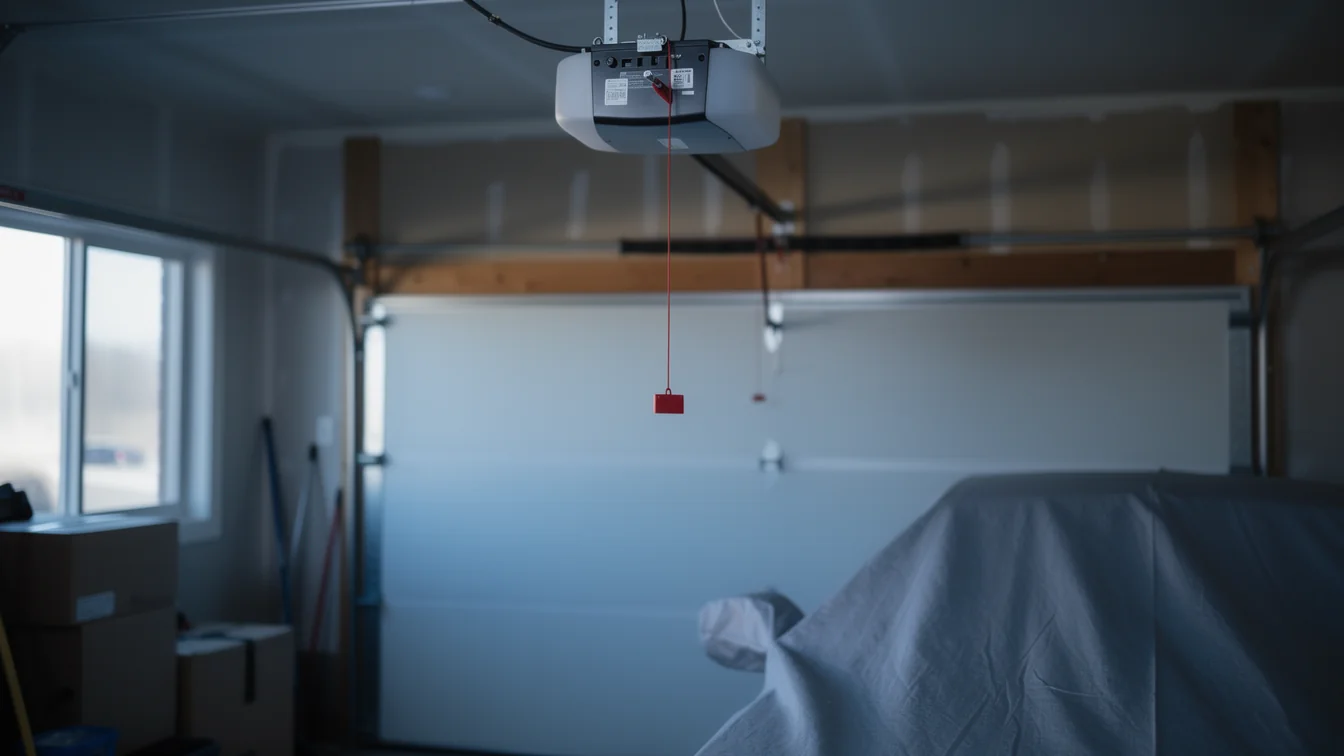
A power cut doesn't care what kind of opener you have, but it matters a lot which kind you own. Across the roughly 86,867 owner-occupied houses in this service area, most garage openers are the age of the housing itself - built well before battery backup became a standard feature on new units. That means when the power goes out, the only way in or out through the garage is the manual release, a cord usually hanging near the rail, and the door has to be lifted by hand.
That's fine if the spring is properly balanced. It's a problem if the spring is already weak or close to failing, because now you're lifting the full weight of the door yourself with no motor assist and no warning that the spring was close to going. We see this combination a lot: an older opener with no backup power, paired with a spring that's been quietly losing tension for years, and the power outage is just the moment someone finally notices.
With a median household income of $84,594 in the area, battery backup upgrades are a reasonable add for households that want the door to keep working through an outage. It's not required equipment, and plenty of these openers have run fine for decades without it, but if you're upgrading an opener anyway, that's the one choice worth weighing before you pick a model.
How we work
What You Pay
We don't have a flat number to quote here, because what you pay depends on what's actually wrong and how old the unit is. A relay or circuit board swap on a newer opener is a different job than sourcing parts for a chain-drive unit that's been running since the 1970s or 80s - and that's the honest limitation worth saying up front: some of those older drive assemblies and belts aren't stock items anymore, and getting the exact match can mean a short wait rather than a same-day fix.
If the opener itself is original to a house built anywhere in that 1958 to 1996 range this area is known for, replacement is often the more sensible call over chasing parts for a thirty- or forty-year-old motor. We'll always tell you when a repair isn't worth it compared to swapping the whole unit, rather than running up a bill patching something that's going to need the same fix again in a year.
We look at the opener, the spring balance, and the wiring condition together before giving you a number, because quoting the opener alone and missing a tired spring just means a second call later.
Questions
Common questions
My opener stopped working after the power came back on. Is it the opener or the circuit?
Check the wall outlet and breaker first - a lot of openers trip off during a surge when power comes back. If the outlet's live and the opener still won't respond, it's likely the logic board or capacitor, which is common on units that have been running since this area's 1960s-70s building wave.
How do I get the garage door open if the power is out and I don't know where the release cord is?
It's usually a red cord hanging from the rail near the motor, inside the garage. Pulling it disconnects the opener so you can lift the door by hand. If it feels unusually heavy, don't force it - that's often a sign the spring is already weak, which is a separate repair.
Should I add battery backup to my existing opener?
Most openers built before battery backup became standard can't just have one added on - it typically means a new opener unit. Given how many houses in this service area have original or first-generation openers, it's a reasonable upgrade to consider next time the unit needs replacing anyway.
Recommendation
You Might Also Like
More garage door guides for San Bernardino homeowners.
What San Bernardino's 1970s Housing Stock Means for Your Garage Door
San Bernardino homes built 1958-1996 need garage door repairs that match original torsion hardware and heat-cracked panels, not generic one-size fixes.
 What a Service Call Actually Covers in San Bernardino
What a service call covers for San Bernardino homes built 1958-1996, how the heat here stresses springs and steel, and what drives the cost of the fix.
 The Noises That Mean Something: A San Bernardino Homeowner's Guide
San Bernardino's 1960s-70s housing stock means specific noises point to specific parts.
Ready when you are
Need a garage door sorted in San Bernardino?
San Bernardino Garage Door Pros repairs and installs garage doors, springs and openers in San Bernardino, CA and the surrounding area.